
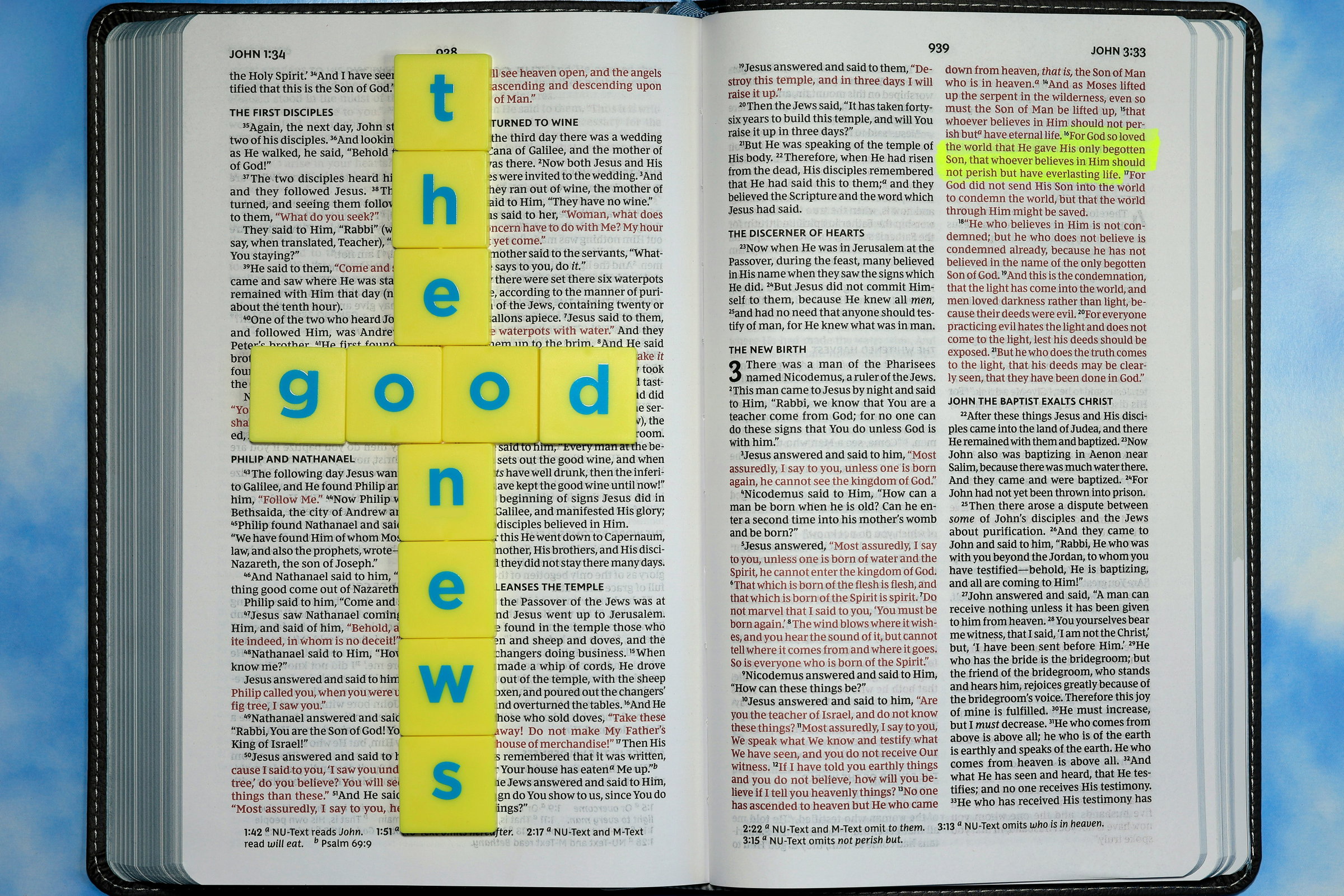

We've Named the Problem. Now the Solution.
Over the past four weeks, we've looked honestly at what drives life-dominating sin: the corrupted desires that press from within, the enthroned longings that come to rule the soul, and the false gospels that sustain the cycle of bondage.
If you've read along with someone you love who is struggling—or if you've seen yourself in these pages—you may be feeling the weight of how deep the problem goes.
That weight is appropriate. And it is exactly the point.
Because the Gospel that Jesus brings is not a shallow solution. It was designed for exactly this depth of need.
The Cross Addresses the Root
The death of Jesus Christ was not primarily a moral example or a legal technicality. It was a cosmic exchange: sin, in all its corruption and enslaving power, taken to the cross; righteousness and life, in all its freedom and fullness, given to everyone who is united to Christ by faith.
"We know that our old self was crucified with him in order that the body of sin might be brought to nothing, so that we would no longer be enslaved to sin." — Romans 6:6
Paul's language here is not metaphorical—it is ontological. Something actually happened to the believer in the death and resurrection of Jesus. The "old self"—that orientation of corrupted desire, enthroned longing, and enslaved will—was crucified. Not reformed. Not improved. Crucified.
This is why the series is called Dying to Live. The path to freedom is not upgrading the old self. It is dying with Christ so that a new self can rise.
The Spirit Renews Desire
But resurrection is not merely a metaphor for self-improvement either. The same Spirit who raised Jesus from the dead now indwells the believer—and the Spirit's work is not primarily behavioral. It is transformative at the level of desire.
"But I say, walk by the Spirit, and you will not gratify the desires of the flesh." — Galatians 5:16
Notice the mechanism: walk by the Spirit. The counter to the desires of the flesh is not self-discipline—it is the Spirit producing new and better desires. The Spirit creates in the believer a hunger for God, for holiness, for genuine communion—desires that, when cultivated, begin to crowd out and displace the corrupted longings that drove the addictive cycle.
This is the transformative engine that no secular program can access and no behavioral intervention can replicate. It is why the local church, gathered around the Word and the Spirit, is not one option among many for the person struggling with life-dominating sin. It is the essential community.
Identity Displaces the Enthroned Longing
When something has occupied the throne of the soul—when a substance or behavior has become the organizing center of a person's life—the answer is not simply to remove it. A vacuum will be filled. The question is what fills it.
The Gospel answers this by offering something that actually satisfies what the enthroned longing was always trying to provide—but could never deliver.
The soul that sought rest in alcohol meets, in Christ, one who says "Come to me, all who labor and are heavy laden, and I will give you rest" (Matthew 11:28). The soul that sought intimacy in pornography meets, in the Gospel, adoption into a family characterized by love without performance. The soul that sought relief from pain through opioids meets a High Priest who "in every respect has been tempted as we are" and who "is able to help those who are being tempted" (Hebrews 4:15; 2:18).
The Gospel doesn't just evict the false ruler. It enthralls the soul with a better King.
The Church as the Place of Transformation
The Gospel is not delivered in isolation. God designed transformation to happen in community—specifically, in the community of the local church, where the Word is preached, the sacraments are administered, believers bear one another's burdens, and the Spirit works through the body.
"Bear one another's burdens, and so fulfill the law of Christ." — Galatians 6:2
Freedom That Lasts exists because this conviction is not abstract theology—it has concrete implications for how the church structures ministry to those struggling with life-dominating sin. Not a referral to a secular program. Not a twelve-step meeting in the church basement. But genuine, Gospel-saturated discipleship, rooted in the local church, addressing the whole person—their corrupted desires, their enthroned longings, their need for a true identity—with the full resources of the Gospel.
This is what the church was always meant to be for. This is what the Gospel was always meant to accomplish.
An Invitation
If you have read this series and seen yourself—or someone you love—in these pages, we want you to know: there is a community near you that is equipped to walk this road with you. Not with judgment. Not with a program. With the Gospel.
And if you are a pastor or church leader who has sensed that your congregation could be doing more for those caught in life-dominating sin—that sending them to secular programs was not the full answer—we want you to know: it isn't. But the Gospel is.
🌱 Find a Freedom That Lasts chapter near you—or learn how to start one in your church—at freedomthatlasts.com. The Gospel gets to the root. Let's go there together.
